# What is this?
First of all, it’s very much a draft. So there’s lots of missing sections, but I’ll keep updating it!
## This is a book for people who want more from their work.
I love my work, and I believe that work is an important, fulfilling part of the human experience. I also *firmly* believe that people should be fairly compensated for their work, but generally are *not*, due mostly to structural inequities. But I also believe that great work can be any task, anywhere, and at any wage. Some of our best work happens for free: in an art project; training for a marathon; volunteering for an important cause; contributing to Wikipedia.
And yet! Work sucks. All great work is hard work, and we make it too hard on ourselves to do great work well.
Some examples:
* Gallup’s longstanding survey of engagement at work is nothing if not consistent. In the United States, only a little more than a third of employees are actually engaged at work. The other half are disengaged. And fully 17% of workers are something Gallup calls “actively disengaged,” which I take to mean *actively* working against their employers and colleagues. Some surveys are even darker: according to BambooHR, [employee satisfaction scores fell 15 times faster between June 2022 to June 2023 than the previous two years combined](https://www.bamboohr.com/resources/guides/employee-happiness-h1-2023).
* Between 1948 and 1973, productivity rose more or less in line with wages (96% and 91%, respectively). Between 1973 and 2014, though, productivity rose 72%, and wages only rose 9%. It’s debatable why this divergence occurred, but my guess is that roughly concurrent development of personal computers has something to do with it, giving executives more overall leverage in the operations of their businesses.
* Studies about the effectiveness of 4-day workweeks show that it’s possible to get 100% of our work done in 80% of the time, meaning most employees are spending 400 hours per year at work that could otherwise be spent with families, friends, or personal pursuits.
So: this book is for anyone who thinks *we’ve gotta change that!* It’s especially for folks who have experienced great work in their lives, or heard about it from friends, and want *more*. And for those of you who think, “Yes, all of that. *And* with a side effect of more human flourishing,” I hope you’ve found your jam.
## This is a book for people who suspect there might be more to the story.
There’s something strange happening that goes beyond ”welp, hard work is hard!”
* For big companies, consolidation and the benefits of scale are culling the less-successful and concentrating success at the top. The tenure of the companies listed on the S\&P 500 is now down to 18 years; contrast that with 60 years in 1958.
* Small companies may have the benefit of unbelievable new technologies that allow faster scale than ever – witness the speed at which Uber or Snapchat reached $1b in capitalization or valuation (around 2-3 years) as compared to the average Fortune 500 company (around 20 years) – but the rate of new firm creation is down 20%, and the share of employment held by new firms is down 17 points.
* Despite the creation and commercialization of amazing new technologies like *cloud computing* and *generative artificial intelligence*, we’re not much more productive as a global economy than we were in \_\_\_\_. (Heck, you can even lump *smartphones* and *email* into this bucket of techologies that should have had a massive impact on productivity, but didn’t.)
## This is a book that introduces a new model to help anyone, regardless of their role in the organization, to participate in the design of better work.
At the beginning of 2020, in the midst of some deep client work on scaled organizational change, I kept feeling like the **language and presentation** of organization design frameworks weren't serving me as well as I wanted.
Everything felt like a thing people *look at*, but don't really do anything about. (That is, unless you're in the c-suite. But the reality is that org design work happens all the time, everywhere in the business. *Not* just at the top.)
I stumbled upon a handful of questions that aren't necessarily new to the org design world, but felt more useful than the existing models in addressing the most important issues for folks up (further from the customer) and down (closer to the customer) the organization.
1. Do we have the right parts, set up the right way? (Configuration)
2. Are we headed in the right direction? (Orientation)
3. Are the right people doing enough of the right work? (Delegation)
4. Are we getting better and smarter every day? (Education)
If we can answer "yes" to all four of those questions, everything will work out OK. When we answer "no" to any of them, things start to get off-track.
The attribute for each item made a handy acronym: CODE.
# Why is it needed?
## Most org design is done by people without training
## Most of the org design frameworks are for execs
[To add: an explainer on the existing models, including their history and use.](#user-content-fn-1)[^1]
The existing models are good, useful tools for diagnosis and design. When cooking this up, I had two main issues that I wanted to address.
1. **The models are all pretty old!** They all predate the information revolution at work, which means they‘re good for understanding the organizations we have today, but less instructive for building the organizations we’ll need tomorrow. I wanted something that spoke to the [animating ideas](https://www.responsive.org/manifesto) of the next generation of work: Purpose; Networks; Empowerment; Experimentation; Transparency. (The even more simplified version of this that we used at August was Open Learning Networks, which I think you’ll see is pretty directly carried through in the model below.)
2. **Each of the attributes in the existing models are important, but othering.** With a few exceptions (e.g. relationships/relating and leadership/leading), they’re about *things*. And those *things* are far from the work. It always seems to set up a dynamic where folks are heckling the organization en masse. *Those* people don't have the right skills. *The* strategy is wrong. *This* process is broken. I wanted a model that could be about *things* and *activities,* to create a new dynamic for OD that gets closer to the work. (Another side note: this is even worse with ideas like “People/Process/Tools,” which almost everyone understands to mean “We need new people, new process, and new tools.”)
We can **decode** an organization or team to find its hidden secrets – revealing what needs fixing, and what should stay the same. We can **recode** an organization or team to get more of what we want and less of what we don’t.
[^1]:
# How is this meant to be used?
To add:
1. Decoding
2. Recoding
3. Macro-level
4. Micro-level
# Introduction
## How should we think about Organizations?
Before we get into the work of improving organizations, we should have a collective understanding of what an organization is*.*
Here’s my definition.
> *The organization is an economic device and embodied idea for achieving a shared purpose that requires the work of many people.*
An organization’s boundaries are best defined by **purpose and participation.** While important, W-9s do not define who is in and out of the organization: shared purpose and active participation do a better job of this task. An organization is fueled by the time, attention and/or money provided by the people who perform or make use of the organization’s work. I’d argue that this even includes customers, suppliers, and stakeholders! Lastly, it is structured by the relationships between the organization and its participants, and within the participant group.
To use a framing from D’Arcy Thompson, **an organization is a diagram of the forces that surround it.**
## How should we think about Operating Models?
Summarizing Amy Kates – one of the most important thinkers in the org design world – an operating model is a **shared idea** that helps “shape human behavior at the group level.” In Kates’ world, an operating model is made up of three interlocking elements: **Ambition, Blueprint, and Integration.**
## Ambition
{% tabs %}
{% tab title="Strategic Choices" %}
{% endtab %}
{% tab title="Distinctive Capabilities" %}
{% endtab %}
{% tab title="Case for Change" %}
{% endtab %}
{% tab title="Business Configuration" %}
{% endtab %}
{% endtabs %}
## Blueprint
{% tabs %}
{% tab title="Organization Model" %}
{% endtab %}
{% tab title="Enterprise Roles" %}
{% endtab %}
{% tab title="Governance & Performance" %}
{% endtab %}
{% tab title="Work & Technology" %}
{% endtab %}
{% endtabs %}
## Integration
{% tabs %}
{% tab title="Teams & Networks" %}
{% endtab %}
{% tab title="Experiences & Processes" %}
{% endtab %}
{% tab title="Data & Tech Architecture" %}
{% endtab %}
{% tab title="Talent & Workplace" %}
{% endtab %}
{% endtabs %}
# Introduction
# Configuration Case Study: Tesla
A quick story about Tesla's ECU Vertical
Toyota and Volkswagen are giants. Maybe not in terms of growth rate and innovation, but certainly in terms of scale. I suspect in a few years when [Toyota's solid state batteries](https://www.ft.com/content/6224f235-568c-4e2f-8247-e7dacf0ef20c) are fully deployed, we’ll be changing our tune, but at least up until today, Tesla's **configuration** in technology set it apart.
The recent teardown of the Model 3 by [Nikkei Business Publications](https://asia.nikkei.com/Spotlight/Most-read-in-2020/Tesla-teardown-finds-electronics-6-years-ahead-of-Toyota-and-VW) highlighted Tesla's advanced **integrated** central control unit. The integration is a significant distinction from the rest of the market.
> Also known as Hardware 3, this little piece of tech is the company's biggest weapon in the burgeoning EV market. It could end the auto industry supply chain as we know it.
An engineer from one of the big Japanese manufacturers looked at it and said, "We cannot do it," and estimated that it would take six years for their firm to catch up to Tesla.
> Most parts inside the Model 3 do not bear the name of a supplier. Instead, many have the Tesla logo, including the substrates inside the ECUs. This suggests the company maintains tight control over the development of almost all key technologies in the car.
My takeaway: the relationships big automakers maintain with long-standing supply chains, helmed by whole departments which tend to fight for their own survival, have hindered their progress here.
This is a **configuration** problem. Which organizational “parts,” set up which way, will help the business achieve its strategy? In the case of Tesla vs. Toyota, the parts include external vs. internal suppliers or producers, defined by the goals of the teams associated with that work. Is it “develop the brain for our self-driving future” or “manage the supply chain for XYZ chip-sets”?
# Configuration Case Study: Toyota
# Configuration Options
For one, there’s the normal stuff that you’ll find in the OD texts:
At the macro level, we can organize according to **Functions,** **Products,** **Geographies** or a mix of all.
We can connect teams and people via **Matrices** (e.g. dual reporting), **Vertical Hierarchies, or Networks.** The latter gets either very little play or outright shade in most traditional OD texts. Time plays a part here – it would have been silly *even in like \~2005* to suggest that an organization of any meaningful scale could be configured as an autonomous network of operating units.
Going beyond that to get closer to the work:
* Our teams can be staffed by a **single discipline** (like a “Center of Excellence”) or by folks covering many, **disparate disciplines** (like a startup, an innovation team, or a matrixed working group).
* Those groups can be **Real Teams**, or some other alternative. We can have **workgroups** that *resemble* teams but are actually independent actors who happen to report to a single person or a steerco. We can have **Chapters** and **Guilds** – as popularized by Spotify – that bring interested or similarly skilled people, respectively, together across different parts of the organization.
* The people in those teams can come from a **single firm**, from **multiple different firms**, or a **mesh of firms and individual people.** Something that doesn’t come up much in the OD process but definitely *should* are configurations that are energized by people, firms, autonomous/semi-autonomous agents, and other APIs, tools, etc.
Each of these configurations demands different ways of working, different sets of tools and techniques. The configurations are informed by different firm or team orientations. Seeing these as a system, with many more variations across a business, is a critical mindset shift for everyone involved.
# How to Choose
Two ways:
1. **Evaluating tradeoffs, ideally with some kind of data.** Every configuration has tradeoffs, and there (probably) is no such thing as a single perfect design. A default-matrix organization will be deeply in-sync for major global initiatives, but will have a hard time being customer-focused or inventing the next amazing thing. Autonomous units will be more customer-centered, but will be “messy” in comparison to a matrix. IMO the best data to inform different organization designs is *time allocation,* mostly because it’s our only non-renewable resource.
2. **Trying different alternatives and seeing what works** (which helps with option 1). This is *always happening* in organizations, but almost never with the kind of formality and intention that we’d like.
Why is this important? Because it defines the product we make. Tesla’s case, above, is a perfect illustration of Conway’s Law.
> Any organization that designs a system (defined broadly) will produce a design whose structure is a copy of the organization's communication structure. — Melvin E. Conway
**Said differently: organization configures the product; organization design is product design.**
# Tool: Good Team Missions
# Tool: Matrix Design Canvas
A tool that helps managers and individual contributors design systems that get better performance out of dual-reporting roles.
TL;DR: If you have two bosses (officially or otherwise), you *probably*are in a matrixed organization, and you *probably* have a few problems that can be solved with this canvas.
For employees and managers in matrixed roles, life is hard.
That's because consensus is hard, and the whole dual-reporting thing was **designed around consensus.**
But in general, managers tend to focus on the individual, rather than the system.
> What’s going on with so-and-so? Why can’t they keep up?
So we might start with [role definition](https://www.cpj.fyi/use-dice-instead-of-raci/) and performance improvement. We could fill out something like the role description below, and hope that things get better.
A minimal approach to role design – you might swap out some items, but these are my favorites
But what contributes to good performance in a matrix is less about the individual, and more about the [ecosystem of goals, incentives, relationships that surround them](https://www.cpj.fyi/org-structure-predicts-code-quality/).
> What instructions is the individual receiving? Are those instructions aligned? If not, what happens?
In practice, the immediate relationship between **functional requirements** (e.g. “what do we think 'good' looks like") and **business outcomes** (e.g. “did the campaign perform to expectations”) matter most but often aren’t designed with intention.
NB: my usual preference would be to [reconfigure the working group into a series of real teams](https://readme.blackglassco.com/how-your-org-structure-is-leaving-millions-on-the-table/?ref=cpj.fyi), rather than sticking with a matrix, but that's not always practical or possible.
## **The Matrix Design Canvas.**
v1.0 of the Matrix Design Canvas
The Canvas is a tool for design, and can be used by managers and individual contributors alike, either to improve their own situation, or to help someone else.
#### How to use it
1. **Current State:** Fill in the canvas based on your best understanding of how things work today, using stickies or text fields in your preferred working environment. Get the truth out there, no matter what you think of it.
2. **Find the Gaps:** In almost every Current State, you’ll find some gaps. A missing or unclear expectation; a broken relationship; goals and incentives that are out of alignment.
3. **Reflect:** How does the current state of the system drive individual performance (positively and negatively)? What might need to change?
4. **Adjust:** Using a new color of sticky-note or text, capture what will need to change in order to get more of the performance that you want. The canvas will make your next steps obvious.
## Glossary
### **Line Manager**
This will usually be a business or P\&L leader, and come in many variations. These individuals usually give direct instructions to the matrixed role, and drive their day-to-day activities.
### **Staff Manager**
This will usually be a function, capability, or department leader, like HR, Insights, or Design. These individuals usually don’t direct the activities of the person in the matrixed role, but influence how they show up.
### **Key Meetings**
These are the forums where the managers align with their peers and leaders. For Staff Managers, these will typically look like meetings to set or improve standards, or to give input on the work of a given team. For Line Managers, these will be sessions that drive the business plan, or integrate the activities of various BUs, departments, or capabilities. Meetings or other similar milestone-like-objects tend to drive a lot of the day-to-day experience for managers' direct reports.
### **Next Level Up**
These are the folks that the Managers report to.
### **North Star**
Instead of using a word like “Purpose” or “Mission,” which might be documented for some roles and not others, “North Star” is the thing that creates direction for an individual.
# Tool: Colleague Letters of Understanding
# Introduction
# Orientation Case Study: GM
A quick story about GM's Test Track
Let’s go way back to the 1970s, to a test track in the southwest United States.
It’s GM’s purpose-built proving-ground for new vehicles, and it’s located there because it puts cars through a lot of challenging situations: altitude, climate, etc.
[The story](https://www.thetruthaboutcars.com/2009/03/inside-gm-mystery-of-crap-interiors-solved/) goes that on a regular basis, GM executives would fly in to test new models for approval. They’d charter in, hop into a chauffeured limo, arrive at the track and drive the cars. In some cases they wouldn't even drive; a pro driver would be at the wheel.
And as it turns out, the cars were *perfect*. Amazing products, on-strategy, and living up to all the standards set out in the plan.
But they weren’t the same cars that were available for sale. They were doctored versions:
> They use a rolling radius machine to choose the best tires, fix the headliner, tighten panel and interior gaps, remove shakes and rattles, repair bodywork—everything and anything.
Because *of course they were!*
It probably only took one gripe from Bob Lutz (CEO at the time) for the manager of the proving ground to push their team to doctor the example vehicles.
> As far as they knew, the cars were exactly as they would be coming off the line. That’s why Bob Lutz thinks GM’s products are world-class. The ones he’s driven are.
There‘s no way any CEO would want this to happen. What leader would want to make decisions about their organization’s future using made-up data?
And yet, things like this happen all the time, whether it’s a PPT dashboard with green-shifted measures, or unaddressed basic technology gaps (read: bad laptops) because execs always have the best available equipment.
This is an **orientation** problem.
{% hint style="info" %}
Orientation and Strategy are deeply connected, but I like the idea of **orienting** more than **strategizing*****.*** Execs and teams need better maps, better compasses, and better goals than they have today. In the GM proving ground example, each of those three portions of the system failed.
{% endhint %}
So, some core questions: Is my organization headed in the right direction? Are we orienting ourselves based on accurate and comprehensive insights? Is there an effective system for measurement and adjustment in place? And, importantly, are the incentives in place driving the desired outcomes?
# Orientation Options
Our options here are different than those in configuration, where we’re picking from a basket of options based on which tradeoffs we prefer. In **orienting** a whole organization or its various component parts, we can use a number of well-understood practices for pointing the business in one direction or another, and apply specific plays based on the situation we find ourselves in.
When the means and ends are clear – think production lines, nuclear reactors, piloting an airplane – we can use **orienting practices** like Six Sigma, Toyota Production System, and even simple checklists to eliminate foreseeable defects.
When either means or ends (or both!) are unclear – think startups, innovation teams, development and implementation of new technologies, and even unexpectedly complex tasks like “integrating across siloes” – we can use **orienting practices** like Lean Startup, Agile, and Consent-Based Decision-Making to harness collective wisdom and customer insight as we make calls.
These aren’t *strategies*. They’re *things we can do* to do a better job of connecting strategy and execution.
{% hint style="info" %}
Aside: there’s a reason why **Orient** is part of the Observe-Orient-Decide-Act (OODA) Loop. Observe-Strategize-Decide-Act (OSDA) is basically the same as Observe-Make a PowerPoint-Maybe Decide-Don’t Act (OMAPMDDA).
{% endhint %}
Some ways of orienting fit better with some configurations, but a key point is that **ways of orienting are learnable and transmissible between teams and organizations.** Strategies, in general, should not be. Otherwise they’re not very good strategies.
# Tool: Future Backwards
The following is a team activity that can replace planning and retrospectives all at once. We absolutely adore this method! It was created by [Dave Snowden, and you can read a robust how-to at this link](https://cynefin.io/wiki/Future_backwards), but a simpler version is below.
As far as facilitation, know\...
* That this session is cognitively challenging. It's a thinker! But it's also easy to facilitate, so you can run the show and participate at the same time.
* It will bring up some "bad stuff" that needs discussing – so be prepared as a leader or facilitator to discuss this "stuff."
* It gets easier the more you do it, and teams will want to do it again in the future.
* You will develop your own way of facilitating it, so don't be afraid to bend the rules if you want to!
Think of this less as a tool to generate "things to go do" and more of a tool that helps teams create vivid, sticky shared intelligence about what they want for the future. We've found that even if nothing is done with the output of the session, simply *doing the session* will generate better outcomes for the team. They'll end up doing more of the stuff they want, and less of the stuff they don't want, than if they hadn't done the session at all.
* **Best for:** Annual or quarterly planning. Scales well to large teams, but a good tip is to divide the group up when it gets >20 people – compare results at the end!
* **Prerequisites:** None
* **Tools:** [These hexagonal sticky notes](https://www.amazon.com/6-Inch-Hexagon-Sticky-Colors-Sheets/dp/B00J40YJCC) were designed for this exercise, and they really do help! Otherwise, regular sticky notes or even a Miro/Mural board will work.
* **Total time:** 1-2 hours
#### 1. Describe the current state (Timing: 5-10 minutes)
As a full group, discuss and write down descriptions that summarize the current state of affairs. Each of these descriptions should be written on a single sticky note. Shooting for 5-7 sticky notes in total, but you'll usually end up with more.
Push the team to vividly describe the situation, rather than using "typical workshop shorthand." Pushing them in this first step will help later on.
#### 2. Describe key events from the past (Timing: 5-10 minutes)
As a group, discuss the most significant event in the immediate past which shaped the current state, and describe it on a single sticky note. Put it next to the current state cluster, and repeat, working backwards in time. You're looking for a single stream leading to today. Try not to jump backward to earlier events – you're looking for what happened, in order.
* The team will ask "how far back in the past?" It doesn't really matter – go as far back as you have time for.
* The team will usually try to assign causal links. This isn't really necessary. Just try for chronological order, if you can.
#### 3. Describe Utopia (Timing: 5-10 minutes)
Imagine, discuss, and write down an IMPOSSIBLY good future. Again, you're looking for 5-7 sticky notes.
You're not looking for “best possible”. You're looking for Impossibly Good. If anyone says something like, "a lot of things would need to change for this stuff to happen," you can respond with something to the effect of, "that's the point!"
#### 4. Describe Dystopia (Timing: 5-10 minutes)
Repeat the process for an IMPOSSIBLY bad future.
#### 5. Backward from Utopia (Timing: 10-15 minutes)
Now, make Utopia happen. Use fictional events to connect Utopia to a past event.
Do this the same way we did when we described the past – working backward without skipping too far.
* Some teams will want to start with a single "thing" from the future and work directly back from there. Other teams will want to be more general. Both approaches work.
* It's usually pretty challenging for teams to think of "the stuff" in this phase. You'll probably see a lot of thinking faces and not a lot of output for at least 1-5 minutes. Don't panic! Give people time to noodle.
#### 6. Backward from Dystopia (Timing: 10-15 minutes)
Repeat the process for Dystopia – use fictional events to connect it to a past event.
#### 7. Discuss (Timing: 10-45 minutes)
You usually won't need a rigorous discussion guide or set of facilitation prompts for this – the reflections will spill out of the team. But definitely give yourself time to reflect on what's on the board!
* What did you notice?
* What surprised you?
* What do you feel about what's on the board?
# Tool: Strategic Compression
## Why use this?
Strategic Compression is a way to improve the **usability of strategic thought.** Most of this *kind* of thinking is created and delivered to an organization in robust, sometimes extreme detail, which increases its momentary quality – it's very accurate given the givens, in the instant that it is created – but difficult to use and adjust with no data. This may be useful for situations that are resource-intensive, but **if your business, project, function, division or team are facing high uncertainty, a more adaptable approach is required.**
Use Strategic Compression...
* When you want to give people simple freedom within a framework
* When you want to enable a team to take action
* When you want to establish heuristics in advance of encountering a situation
* When you want to make prioritization judgment calls easily portable throughout an org
## **What is Strategic Compression?**
The art of simplifying strategy into the most useful, editable, atomic version of itself, using some form of compression. This guide covers two compression styles:
1. Articulating the strategic choice being made in the format of \[good thing A] even over \[good thing B]
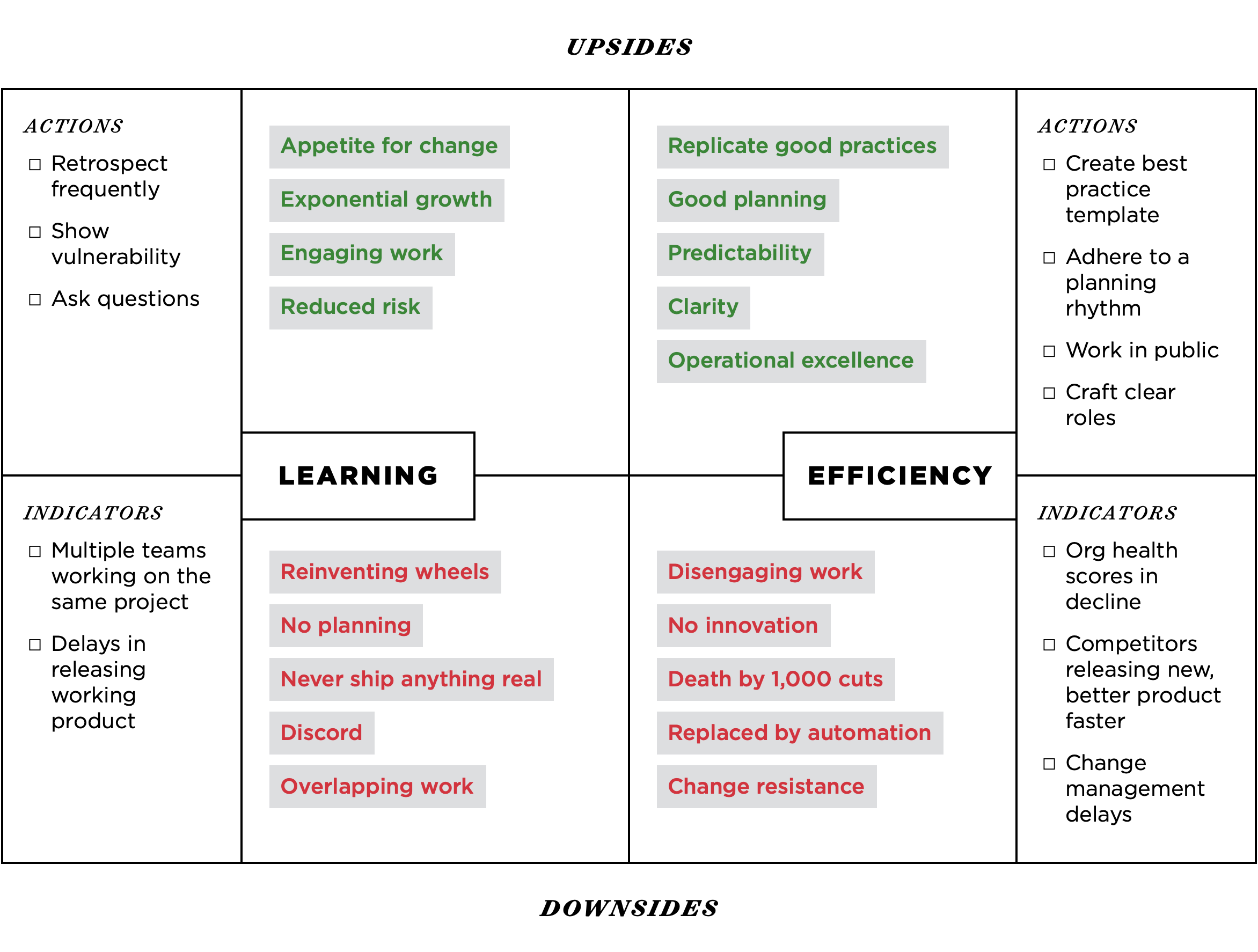
2. Articulating upsides, downsides, and actions associated with the two opposing "good things" you'll prioritize
### **Style 1: Good Thing A over Good Thing B**
If you're looking for a simple – but quite difficult – method for capturing your strategic thinking, try expressing it in terms of one good thing that you're selecting, *even over*another equally good, valuable thing. You're probably thinking, "this sounds super easy!" but folks screw it up their first few (hundred?) times they try. This gets much, much easier with practice, though, and there are two pitfalls to avoid:
#### **Big Error Number One: Good Thing Even Over Bad Thing**
> Run profitably *even over* Go out of business
This might be an indication that there are some big problems in the business that are worth solving, but these things don't tend to represent high-quality strategic choices between two equally valuable paths. Think of it this way: you're trying to identify something really, really valuble that you're going to actively decide NOT to pursue over the next while. And perhaps use those "bad things" that you've generated as a source of inspiration for process optimization, automation, or waste-elimination.
#### **Big Error Number Two: Wordy/Boring**
> Flawlessly execute our three big bets (launching our new product; expanding to the next city; improving customer service) *even over* Optimizing existing operations
Just say: *Big bets even over Existing ops*. You can write down what the big bets are, and what you mean by "existing operations," in other documents. The goal with compression is to make something catchy and portable that simplifies decision-making. The more additional noise you apply to *qualify* the signal, the less portable your strategy becomes.
#### **And another thing...**
I've never tried this in practice, but I expect that this same construct would work with *Bad Thing A over Bad Thing B*.
> Reduce salaries *even over* Reduction In Force
### **Style 2: Maximizing Two Good Things**
Back in 2014 (I think?) the brilliant Debra France of W\.L. Gore came to visit me at Undercurrent. We were talking about the style of strategic compression described above, and she made the remark, "Picking one thing over another is driven by a scarcity mindset. It's pretty old-fashioned, don't you think?"
Debra showed me how to identify the good and bad that are created by absolutely maximizing one end of a given polarity. Over-optimizing for openness over closed-ness comes at a cost, and we should be able to figure out a way to get the best of both worlds. It's pretty straightforward to do, once you've done the hard work of identifying the polarities that are driving challenges (and successes) in your work. Just make a 2x2, with the polarity along the X axis, and upsides and downsides along the Y axis. Fill it in.
Then identify what you (or the team) are going to do in order to pursue the upsides for both poles, and what signals you're going to watch for that might indicate you're getting the downsides of either pole. Assign the actions, and consider dashboarding/tracking the indicators.
## How-To
This compression technique works equally well for individuals, teams, and entire organizations, and the method for getting to them can be as simple as, "the highest-paid person writes them down" and as complex/drawn out as, "we ran a full-scale program to get to cross-org agreement on these things." The "right" way to do this is probably somewhere in the middle, and should always involves the following steps:
### **Step 1: Get clear on boundaries**
Write down:
1. For whom or what these strategies apply;
2. From what authority they originate; and
3. How long the strategies are in force.
Be as clear and precise as you can be.
"In my role as President, I'm setting the following strategies for the whole of our North America division for Calendar Year 2022.
"For the next quarter, the Website Team is collectively agreeing to abide by the following strategies on the new .com launch; we will get together in the first week of Q2 to assess and adjust."
### **Step 2: Assemble and review high-quality input**
Pull together a range of data, anecdotes, and examples to help ground your thinking in external and internal signal. It may occasionally be appropriate to work from your own opinion or point of view – say, when you're just starting out! – but the act of assembling data before making judgments is a good habit, and a wonderful group activity. With a few people silently jotting notes on post-its or a shared whiteboarding space (a simple Google Doc is wonderful for this!), in the span of 10 minutes, you'll have a robust picture of what's going on in the business.
### **Step 3: Make a lot of options**
Because the wording of these things is *the magic* and getting the right wording for anything is quite difficult (let alone something that is intended to guide human behavior), you want to generate a wide variety of options from which you can select, mix, and match. Brute force is the way to go here: use whatever medium allows you to quickly write down as many \_\_\_ even over \_\_\_, or \_\_\_ and \_\_\_, as you can in 5 minutes. I like post-it notes for this purpose, but again, a Google Doc/Google Sheet will do for the typers and remote workers.
### **Step 4: Select a handful to try**
Now, pick a few. If you're the boss, and you've followed the steps above, you should feel confident to go ahead and pick the ones that make the most sense to you. If you're working as a team, anonymous voting should give you the data you need to make a clear call. Or try the [election process](https://www.cpj.fyi/elections/).
### **Step 5: Test immediately**
Test them by trying to write down a few commitments, action items, or projects that you can make, or that would change as a result of putting these new strategies into place. If it's not obvious that things are going to be better (or at least a little different) after adopting them, they probably need a little work or amendment.
### Further Reading
{% embed url="" %}
{% embed url="" %}
{% embed url="" %}
{% embed url="" %}
# Tool: Live Dashboards
# Introduction
# Delegation Case Study: Large Healthcare
A quick story about Decision-Rights in a Large Healthcare Org
In 2019, my team and I collaborated with the senior leadership of a large healthcare organization grappling with a perceived innovation deficit within the depths of their expansive workforce. The CEO had initiated a program for mid-level leaders to propose alternatives to the operating model, but the path forward was unclear.
Our diagnosis revealed an unexpected issue: the problem was not with the strategy, staff or structure, but in decision dysfunction at the upper levels of the organization. Senior leaders' disputes over roles and responsibilities were preventing good ideas from getting to the market in a reasonable time.
In an exercise reviewing the past year's senior leadership meeting agendas, we found that **65% of the items,** which ranged from high-level vision to minute budget approvals, **shouldn’t have even made it to the meeting.**
Why was the next level below the LT inappropriately escalating items? Because their decisions made in mid-level forums would tend to get shot down by a leader in a different part of an organization that didn’t agree with one aspect or another in the proposed approach.
> Why use the designated decision forums when those forums don’t really have any sticking power? We may as well just send it up to the leaders and let them sort it our amongst themselves.
No wonder the organization struggled with accountability and empowerment.
This is fundamentally a **distribution of authority problem.** Are the right people in this organization doing enough of the right work? At what pace layer of the organization is the integration happening? Are norms around shared decision-making helping different parts of the organization work better together?
# Delegation Case Study: Zappos Adaptive
# Delegation Options
Sources of authority
Means of distributing it – Explicit, which tend to look and feel like formal schemes of dealing with who is in charge of what. Bureaucratic, Democratic, Sociocratic Distributed Ledger. Implicit, which tend to feel much more informal / Charismatic
Level of distribution/Integration – Centralized, Decentralized, and Pace Layers
# Tool: Elections
Instead of having The Boss Decide™, use this facilitation method to make the wisest decision possible with the minimum amount of preparation and politics.
## Why use this?
Elections are an alternative to normal, usually tacit methods for deciding who **should**do the work. Note that I’m emphasizing **should:** the idea is not to get to who wants to do the work, or who has to do the work, but rather the **best possible person to do the work right now**.
Run elections this way, because most alternatives encourage gaming, bias, and politics. This is also known as *business as usual*.
## What are Elections?
It is a structured group facilitation method for gathering emergent wisdom from the group with the minimum amount of preparation. That wisdom is used by the facilitator to recommend who gets to fill the role or job. For small, well-practiced groups, it can take as little as 15 minutes per role to be elected. For larger groups, budget at least an hour per election.
### **What can Elections replace?**
1. **The Boss Chooses By Themselves™** can work well with great, informed, openminded bosses. Most of the structured steps below are the ones that good managers undertake anyway – gathering data, canvassing, making their inputs and ultimate decision clear. This is a fragile system, though – it requires substantial training and maintenance.
2. **Direct voting and instant runoff voting (IRV)** encourage folks to campaign outside of the process. It seems fairer to do it this way, but it doesn't end up any different from how it works “normally,” where folks spend weeks, months, years, careers! working toward a given position. It just makes it public, and reduces the wisdom of the group to a) what individuals say their capabilities are and b) the tally-able votes of individuals. If you’re trying to level the playing field and make the wisest decision, voting methods aren’t the way forward. IRV adds a bit more data – ranked preference – but it also means educating people on the system and finding a digital method to tabulate the votes...and eventually dealing with a culture of gaming the ranked voting system. The juice isn't worth the squeeze.
3. **Committee Selection** can yield similarly wise results to the method outlined below, but doesn't do much to resolve politics and gaming. Also – who chooses the committee? What method do they use? Good committees make this transparent, but again – this is fragile and subject to change.
Instead, why not commit as a group to follow a process?
**Use Elections for any important decision.** It doesn't need to be exclusive to electing humans to fill roles – it can also be used to pick between strategic or tactical options – all you need is a clear problem statement, to replace the "role to be filled" and a set of concise options for how to move forward, to replace the "candidates."
## Explainer
### **Preparation**
* **A clear role description:** obvious but overlooked. Most role or job descriptions are overlong, under-describe outcomes, and over-prescribe actions, but we'll save that for another guide. One *very helpful* thing to consider when crafting the role for election: what's the duration of the appointment?
* **Time for making the decision.** There are five (optionally six) steps to the process; for each role that you're electing, budget a baseline of 15 minutes plus five minutes per person in the group. For a team of seven people, that's about 50 minutes. Teams get better at this over time, and wiser about who should do what, so don't let this time budget get you down. This leads to...
* **A list of participants and an invitation to participate.** If the list of participants is more than nine people, consider ways to shortcut some of the steps: gather nominations and rationales (Steps 1 and 2) via a survey, and circulate a readout of those nominations/rationales before jumping straight into Step 3.
* **A method for gathering and sharing nominations in the moment.** Email or private messaging will do for remote groups; scrap paper or post-its works well for in-person groups. Video-conferencing is important but not essential for the quality of the decision.
* **A decision for who will facilitate.** This is a big one. For groups new to elections, I recommend the person with the most positional authority to start; this will shortcut questions of legitimacy. Eventually, groups should elect their facilitator, and that person should hold the role for at least a quarter.
### **Step 1: Present role description and collect nominations**
*Describe the open role or job, and silently gather members’ desired candidates on individual ballots; post for all to see*
Spend whatever time is necessary getting clear with the group what *work* is before collecting nominations. Allow questions and discussion if it's helping the group get clarity.
As a facilitator, the main concern in the collecting-ballots moment is doing so in a way that the group doesn't anchor around a particular candidate – anchoring will reduce the quality of the decision. Remember: we're not looking to find out who wants to do a job, we're looking to determine who *should* do the job. Put the nominations up where folks can see them – for example, on a text file that you share on screen if any of your participants are remote.
Be sure to identify who made what nomination. This is important for all of the later steps of the process.
As the facilitator, it's up to you (or the presiding team rules, if they exist) whether you participate in the nominating. You'll be making the final recommendation to the team, so your participation may indicate bias – have a think about this.
### **Step 2: Illumination**
*Ask each individual: “What are the reasons for selecting your candidate?”*
Once everyone can see everyone else's nominations, ask each participant to share only positive reasons why they selected their candidate, and *not* share reasons why they *didn't* select someone else. As a facilitator, don't let folks interrupt each other or ask questions for clarity. The rest of the steps will get folks the clarity they need, and once everyone has shared, there will be *enough*information in the room to make a high-quality decision. Let folks pass if they need more time to think, but be sure to remember to come back to them.
For this step and the next, it's not necessary to capture any notes or verbatim responses to the prompt, unless that's necessary to accommodate for individuals in the group. Most organizations don't need *or ever use* a record of the inputs to the election – I recommend just capturing the outputs.
As a facilitator, though: jot down some rough bullet-point notes to yourself to aid in your summarizing and recommending in Step 5.
### **Step 3: Information Gathering**
*Ask each individual: “Is there anything else you would like to share?”*
Now is a chance to bring the overall context into the decision – if you think it's important that folks know why they shouldn't choose a particular candidate, this is the time to bring it up. There's no need to remind participants of this – simply asking if there is *anything else* will prompt the right information. Again, don't allow interruptions, questions, or discussion, and allow folks to pass if necessary.
### **Step 4: Change**
*Ask each individual: “Do you want to change your nomination? If so, please share the reason why.”*
Now, with ample data to support a wise decision, ask each person in turn whether they would like to change their nomination. As a facilitator, capture the changes as they happen. A few things to consider here:
* Remote groups can use co-working software, like Google Drive, to collaboratively edit their nominations on a shared screen.
* Well-practiced groups will want to speed through this round, readily accepting a growing "wisdom of the group." Let them follow this instinct to go with the flow, unless you sense that individuals are being railroaded into a decision that they don't believe in.
### **Step 5: Proposal**
*Facilitator summarizes the nominations + arguments, selects a candidate with the strongest arguments for election*
The four preceding steps will yield a shortlist of nominees – usually three at most, usually with a clear majority opinion. **It's up to the facilitator to summarize the arguments made by the group and select a candidate.**
For many groups, especially those where the person with the most positional authority is the facilitator, the process can end here: *the boss has made an informed decision about who should do what*. It should progress naturally to a small round of applause for the person selected.
For an elected facilitator, this is a heavy, important, cognitive and emotional task. They're being asked by their peers (or in some cases, superordinates or clients!) to make a career decision for the group. If this is you: step into this role with confidence – the people want you to do this for them. And if you're concerned with fairness, understand two things:
1. How fair was the process before? Is this more or less fair, in general?
2. There is a ton of social pressure and group supervision built into this process – it would be extremely unlikely for a facilitator to go against the wisdom of the group.
If you're still concerned, add a sixth step:
### **Optional Step 6: Consent**
*Ask the group: “Are there objections to electing … ?”*
Check with the group to see if there are any objections. This is the last chance to *ensure the right person is being elected to do this work,* at least until we can gather again when we have more data. Leave some open air to encourage people to jump in if there *are* objections – reasons why this is an unsafe thing for us to do – and spend time discussing, as a group, how to resolve these objections. Some tips:
* Ask folks with objections to offer a counter-proposal, and then ask the group if there are any objections to this new way forward
* If there's no counter-proposal, dig into the objection to find the root of it. Look for reasons why this is an unwise choice for the business or the outcomes the org is trying to achieve and resolve those – avoid solving for preference.
* Default to time limitations – can we come back in a month, or a quarter, to revisit this decision?
Along the way, look for nonverbal cues that the group is making a bad call – crossed arms, posture changes, sighs, checked-out eyes. If you're getting this feeling, check-in with folks that are checking-out.
# Tool: Pace Layers
In 1989, [Elliot Jaques proposed six different, hierarchical strata of work](https://www.amazon.com/Requisite-Organization-Effective-Managerial-Leadership/dp/1886436045/ref=sr_1_1?keywords=requisite+organization\&qid=1651002631\&s=books\&sprefix=requisite+o%2Cstripbooks%2C63\&sr=1-1\&ref=cpj.fyi), defined by their complexity (and the time-span of their authority).
## **Jaques' Six Layers**
1. Executes against a prescribed, linear path (90 days);
2. Can reflect on potential problems and diagnose (3-12 months);
3. Understands entire process and has preplanned ways to respond (1-2 years);
4. Parallel processes several interacting variables – make trade-offs (2-5 years);
5. Applies judgment against constantly shifting events – intuitive and diagnostic challenges (5-10 years);
6. Creates an environment for the entire organization to succeed (10-20 years).
I think of these hierarchical layers as levels of **leverage** that different people, or teams have with their work. Level 6 has more leverage than Level 1, say – because its time-span is longer.
In 1994, [Frank Duffy defined the idea six of "Shearing Layers"](https://www.amazon.com/How-Buildings-Learn-Happens-Theyre/dp/0140139966?ref=cpj.fyi) for building. [Stewart Brand expanded on this idea in 1999](https://www.amazon.com/Clock-Long-Now-Responsibility-Computer/dp/0465007805/lono0a20?ref=cpj.fyi), with six "Pace Layers" for civilization: "The fast layers innovate; the slow layers stabilize. The whole combines learning with continuity."
And then in 2011, [Stephen Drotter identified six layers of organization](https://www.amazon.com/Performance-Pipeline-Getting-Right-Leadership/dp/0470877286/ref=sr_1_1?crid=8LCU2JRYNOLZ\&keywords=performance+pipeline\&qid=1651002677\&s=books\&sprefix=performance+pipeline%2Cstripbooks%2C71\&sr=1-1\&ref=cpj.fyi), defined by their unique value-producing role.
## **Drotter's Six Layers**
1. Define the corporate strategic framework, including vision, mission, and values;
2. Create a business strategy to deliver short- and long-term profit, based on the business unit's role in the portfolio;
3. Manage each function to achieve a competitive advantage that supports the strategies;
4. Use functional capability and annual operating plans to deliver productivity, standards, information, and decision-making;
5. Manage clearly defined roles and train and develop people to enable the delivery of results;
6. Produce and execute the designs, products, services, sales, and fulfillment promises against the business plan.
I was personally struck by the uniformity of this thinking across time and discipline – in general, there are six different levels of escalating complexity, each interdependent, each with an important role.
Important to note here that in my table, "Leverage" is not the same thing as "Time to complete something."
* Writing the values for an organization (Level 6 work) could only take a few minutes of "work," but when done well could influence the lives of millions over the span of decades.
* Making an ad campaign (Level 2 work?) could take a year, but might only influence culture and buying pattern for a few months. Or more! *This is a thinking tool. Use it to think!*
And then in 2021, [John Cutler identified nine Mandate Levels](https://cutlefish.substack.com/p/tbm-2752-mandate-levels?s=r\&ref=cpj.fyi), primarily for teams working on or around software. The brackets in each are meant to be fill-in-the-blank/choose-your-own-adventure.
## **Cutler's Nine Mandate Levels**
1. Build exactly this \[to a predefined specification]
2. Build something that does \[specific behavior, input-output, interaction]
3. Build something that lets a segement of customers complete \[some task, activity, goal]
4. Solve this \[more open-ended customer problem]
5. Explore the challenges of, and improve the experience for, \[segment of users/customers]
6. Increase/decrease \[metric] known to influence a specific business outcome
7. Explore various potential leverage points and run experiments to influence \[specific business outcome]
8. Directly generate \[short-term business outcome]
9. Generate \[long-term business outcome]
These felt **so similar** to the Pace Layers from Jaques and Drotter that I felt like they needed to be mashed into one, comprehensive look at the Pace Layers and Generic Missions/Mandate Levels that live within an organization.
So I filled in the blanks in **Level 2:** **People management and training,** **Level 4: Functions and capabilities as a source of advantage,** and **Level 6, Corporate strategic framework, including vision, mission, and values.**
I personally find this end result **very, very useful.**
For one, you can overlay a number of different concepts, including [Alfred Chandler's 1962 definitions of Strategy, Structure, and Tactics](https://www.amazon.com/Strategy-Structure-Chapters-Industrial-Enterprise/dp/158798198X?ref=cpj.fyi).
## **Chandler's Three Definitions**
* **Strategy:** The plan for the allocation of resources to anticipated demand.
* **Structure:** The design for putting the enterprise’s existing resources against current demand.
* **Tactics:** The efficient and steady use of current resources whose allocation had already been decided.
You can also drop the late [J. Richard Hackman's 2012 Authority Matrix](https://www.amazon.com/Leading-Teams-Setting-Stage-Performances/dp/1578513332/ref=sr_1_3?crid=YP1DMCN3PFYQ\&keywords=leading+teams\&qid=1651002814\&s=books\&sprefix=leading+teams%2Cstripbooks%2C68\&sr=1-3\&ref=cpj.fyi), showing the difference between Manager-Led Teams, Self-Managing Teams, Self-Designing Teams, and Self-Governing Teams: each successive step toward self-governance consumes more and more of the "stack" of Organizational Pace Layers into a single team.
I've also added a new layer to Hackman's Matrix: a Self-Governing Organization that incorporates collective wisdom into the slowest-moving, highest-leverage, foundational aspects of the firm.
This explains a good deal of what works and doesn't work for teams, especially when it comes to their mission. For highly capable knowledge-work teams (marketing teams, software teams, research team, etc.), low-leverage missions tend to be uninspiring. They need something in the **G. Solve this \[open-ended problem]** to **N. Generate \[short- or long-term business outcome]** range, not something like **"Launch Product X in Market Y by Date Z."**
And when teams have something important to do in rows A, D, E, F, J, and L, all at once, it's obvious that they'd have cognitive overload and struggle to do any of those tasks with flow.
# Introduction
# Education Case Study: OECD
A quick story about Productivity and the OECD
Close to a decade ago, the OECD released a handful of papers on the future of productivity. The goal of their research was to put put productivity – the ability of firms to create value – at the top of global policy-makers’ agendas.
HBR pulled out the punchline from these papers: **there are two basic clusters of companies, and they grow at dramatically different rates.** Frontier Firms, and Everybody Else.
**Frontier Firms,** as the papers describe, have been growing at several times the rate of the rest of the economy, but their growth rates have slowed in recent years. The papers are thin on simple conclusions, but if you read between the lines, the differences between Frontier Firms and everybody else are clustered around two key factors: **their technology literacy and use of “knowledge-based capital” (KBC).**
{% hint style="info" %}
From the moment I heard that phrase, “knowledge-based capital,” I was hooked! So much more interesting than “knowledge management,” but points to the importance of intentionally growing, maintaining and spreading knowledge in a firm to create a sustained advantage.
{% endhint %}
* **Technology Literacy** is the ability of an organization to understand, use, and manage technology to meet its goals. Think: skills and knowledge to operate, evaluate, and innovate various technological tools and systems. And not just the most deeply “technical” stuff. Even basic things like *mouse skills, calendaring* and *email practices* would fall into this bucket. More Tech Literacy: smarter tech investments, better adaptations to new technological trends, and a culture of continuous learning and innovation.
* **KBC** is about what the organization knows, and how well it puts its unique knowledge to work. And it is best defined by the categories from [this paper](https://www.nber.org/system/files/chapters/c0202/c0202.pdf) by C.A Corrado, C.R. Hulten and D. Sichel:
**Computerized Information**
1. **Software:** Improved process efficiency, ability to spread process innovation more quickly, and improved vertical and horizontal integration.
2. **Databases:** Better understanding of specific consumer needs and ability to tailor products and services.
**Innovative Property**
3. **Research & Development:** New products, services and processes, and quality improvements to existing ones. New technologies.
4. **Copyright and Creative Assets:** Artistic originals, designs and other creative assets for future licensing, reproduction or performance. Diffusion of inventions and innovative methods.
5. **New Designs:** New designs leading to output in future periods. Product and service quality improvements, novel designs and enhanced processes.
**Economic Competencies**
7. **Brand-Building Advertisement:** Improved consumer trust, enabling innovation, price premia, increased market share and communication of quality.
8. **Market Research:** Better understanding of specific consumer needs and ability to tailor products and services.
9. **Worker Training:** Improved production and skill levels
10. **Management Consulting:** Externally acquired improvement in decision making and business processes.
11. **Internal Organizational Investment:** Internal improvement in decision making and business processes.
When you look at those items, and you think about two exemplar workforces at either end of a spectrum between high and low technology literacy, it's obvious why the growth disparity is what it is. Firms that are better at this "stuff" have a massive advantage over those that are worse.
This is more than a *tools* problem. It's a problem rooted in a firm's approach to **education.** How does information flow from sources to recipients? How do employees gain new skills, and from where? How much time is dedicated to learning? How do leaders and teams unlock trapped sources of KBC? How are people rewarded for contributing to a company’s KBC?
# Education Case Study: Large CPG
# Education Case Study: Airbus
# Tool: Readmes
# Tool: Interfaces
# Tool: Practices